Do I need a website?
Five honest questions to decide if a website makes sense right now — with concrete examples and a 10-minute self-assessment.
A website is not a badge of professionalism. It is a tool — and only worth it if it solves a real problem.
The right question is not «do I need a website?». It is: do I have a problem a website solves better than the alternatives?
Many people build one because «every business has one». Others avoid it because it feels expensive or complicated. Both waste time. This guide helps you decide with clarity — even if the answer is «not yet».
Overview
What a website does (and does not do)
A website does not replace:
- word of mouth and referrals;
- an active Instagram where you already have an audience;
- a well-filled Google Business Profile (for local businesses);
- the quality of your work.
A website can help when:
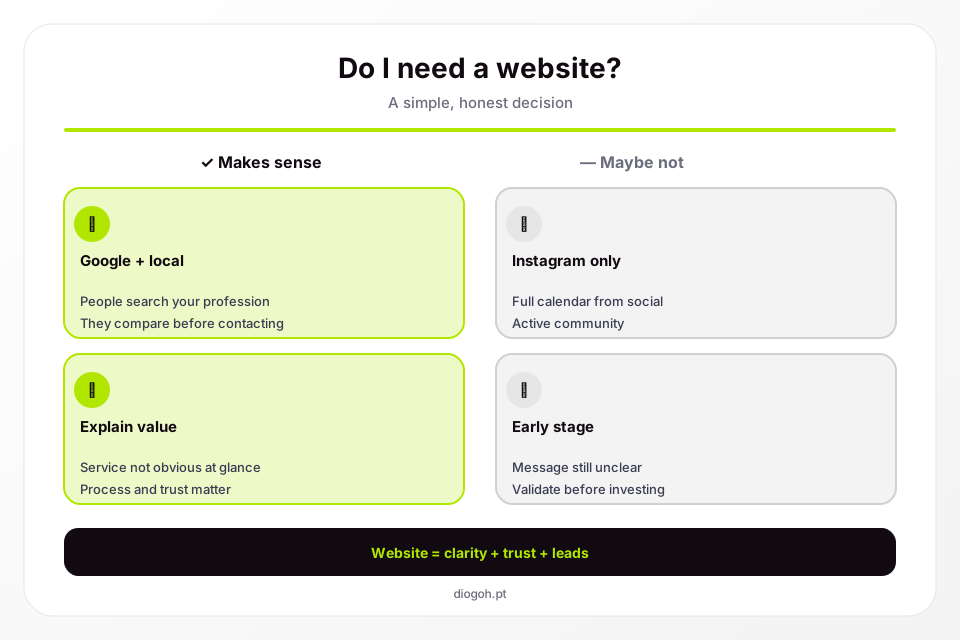
- someone searches for you on Google and needs to understand in 30 seconds if you are a fit;
- what you do requires explanation (not obvious at first glance);
- you want a place of your own where information does not disappear in the feed;
- you need to turn visits into enquiries predictably.
Think of a website as a digital waiting room: the visitor enters, understands who you are, what you offer, how it works — and decides whether to move forward.
Five questions to decide
Answer honestly. You do not need to score — but if you say «yes» to three or more, a website probably makes sense now.
1. Do people search for you online before getting in touch?
Try this: open Google in a private window and search your profession + city. Do you appear? Do competitors with clear websites appear?
Example: a psychologist in Manchester. Searching «psychologist Manchester» shows dozens of results. Whoever is not visible depends only on people who already know them. Whoever appears with a clear site gets enquiries from strangers.
Counter-example: an electrician with a full diary from building referrals. Google brings few new leads. A website helps less than a phone number on a business card.
2. Does what you do need more than one sentence to explain?
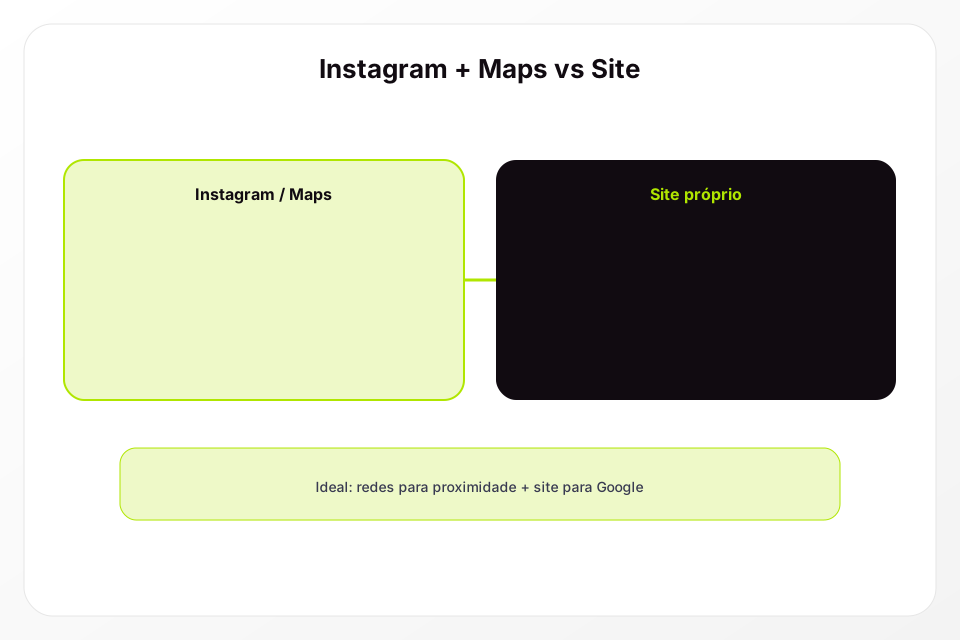
If you can say «I am a hairdresser in X» and people get it, Instagram + Google Maps may be enough.
If you say «I am a process consultant for SMEs in food manufacturing» and see confused faces, you need space to explain: who it is for, what problem you solve, how it works, how long it takes, what happens next.
3. Are Instagram or LinkedIn enough for what you need?
Social media is great for showing and connecting. Websites are better for explaining and organising.
| You need to… | Social media | Website |
|---|---|---|
| Show recent work | ✓ | — |
| Explain services in detail | Limited | ✓ |
| Appear in Google search | Weak | ✓ |
| Bookings / fixed form | Possible, but scattered | ✓ |
| Content that does not disappear | ✗ | ✓ |
Many businesses need both: Instagram for closeness, website for clarity and search.
4. Do you already have clarity about what you offer?
A website amplifies your message. If the message is still fuzzy, the site will be fuzzy — and more expensive to fix later.
Mini exercise (10 minutes): write one sentence completing this:
«I help [type of person] achieve [concrete result] through [how].»
If it takes more than 10 minutes or the sentence stays vague («I help people be better»), the step before a website may be clarifying your offer.
5. Do you have time (or someone) to maintain it?
An abandoned site — 2019 prices, dead blog, wrong hours — sends the opposite of professionalism.
If you will not update at least contact details and services once a year, consider a simple landing page or a well-maintained Google Business Profile first.
Three concrete scenarios
Scenario A — «I am just starting, zero clients»
You probably do not need a full website. You need to validate whether anyone will pay for what you do. Instagram, networking, local groups, or a test landing page usually suffice.
Signal to upgrade: you keep getting the same DMs («do you do online?», «how much?», «do you work with teenagers?») and you are tired of answering.
Scenario B — «I have clients, I want predictable growth»
A website makes sense. You want searchers on Google to find you and understand without messaging you. You want to look as organised online as you are in your work.
Priority: one clear page (or three: services, about, contact) well written — not eight empty pages.
Scenario C — «Diary is full, I just want to look professional»
It depends. If all clients come by referral and you do not want to grow, a website is a luxury — a digital business card. If you want to raise prices or filter clients (attract the right ones, repel the wrong ones), a well-written site helps a lot.
Alternatives that often suffice
Before investing in a full website, consider:
- Google Business Profile — essential for local businesses. Free, appears on Maps.
- Landing page — one page, one goal (bookings, waitlist, launch). Cheaper, more focused.
- Link in bio — Linktree or a simple page with contact, services, FAQ.
- Newsletter — if the goal is audience, capturing emails sometimes matters more than a site.
Common decision mistakes
Building a site «to look professional» without knowing what to write. Result: generic site nobody visits.
Copying a competitor’s structure («they have a blog, I want one too»). A blog without regular content is worse than no blog.
Assuming website = marketing. A site is a destination. You still need traffic: Google, social, referrals, ads.
Expecting the site to «sell on its own». A clear site reduces friction. It does not replace reputation, price, or timing.
Summary: when yes, when no
Makes sense now if: people search for you on Google, you need to explain your service, you want independence from platforms, and you have (or will have) clarity on what to write.
Can wait if: business not yet validated, all clients come by referral and you do not want online growth, or you cannot yet articulate what you offer.
Never need is rare — but a 100% offline business with no growth ambition can live on phone and card alone.
If after this exercise a website makes sense — but you do not know where to start with the message — the 2-minute qualification helps clarify scope. Reply within 48 hours, no obligation.
Ready to take the next step?
Pick a plan, browse models for your industry, and request a proposal — reply within 24 hours.