Website, Instagram, or landing page?
It is not either/or — it is a combination. A practical framework for what to use at each stage of your business, with real examples.
Instagram, a landing page, and a full website do not compete. They serve different moments.
The question «website or Instagram?» assumes you must pick one. In practice, most businesses that work online use more than one channel — but at different stages.
This guide explains what each does well, when one alone is enough, and how to combine all three without spreading yourself thin.
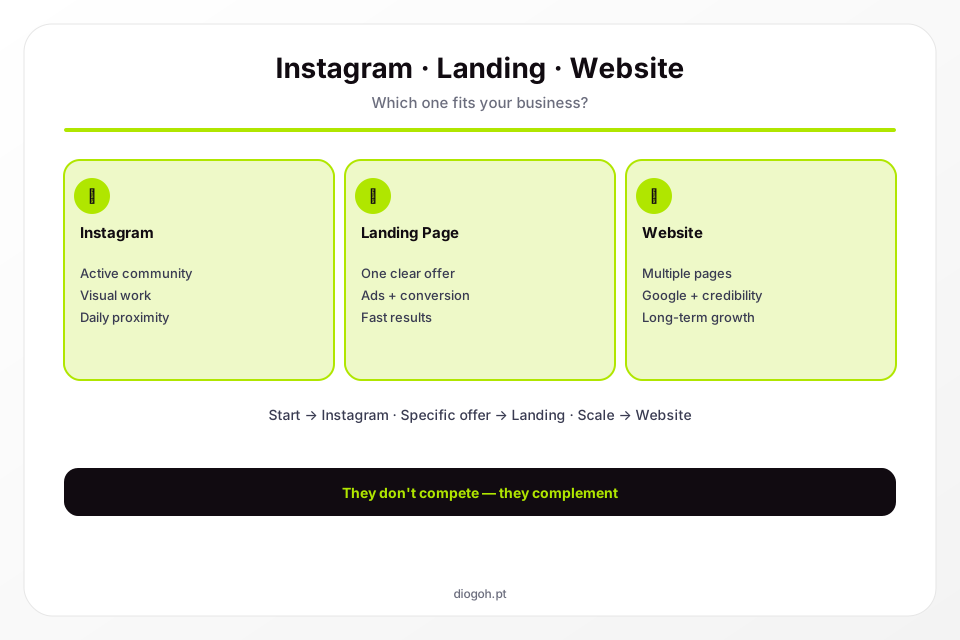
Three tools, three jobs
| Tool | Main job | Analogy |
|---|---|---|
| Show, connect, social proof | Live shop window | |
| Landing page | Convert on one goal | Campaign poster |
| Full website | Explain, organise, rank on Google | HQ with all the rooms |
Confusion happens when you use Instagram to explain what a website explains better — or build a five-page site when a landing page would do.
Instagram — when it is enough (and when it is not)
Works well when:
- the work is visual and self-explanatory (food, hair, crafts, interiors);
- you already have an active community that comments and shares;
- clients come by referral and Instagram is a natural extension;
- you post regularly (3–5×/week) and enjoy the process.
Real limitations:
- Organic reach is unpredictable. A post may reach 200 people or 20 — the algorithm decides, not you.
- Information gets buried. Prices, hours, FAQ scattered across posts, stories, highlights — visitors tire of searching.
- It is not yours. Suspended account, platform decline, rule changes — years of content gone instantly.
- Google does not index it well. Someone searching «therapist Bristol» will not find your Instagram profile in top results.
Concrete example:
Maria, artisan bakery. Instagram is enough: cake photos sell, local followers order via DM. Urgent website? No. Google Business + Instagram may suffice until she wants structured online orders.
Rui, sports physiotherapist. Instagram shows cases (with consent), but explaining protocols, insurance, locations, and bookings in a 150-character bio is impossible. He needs a landing page or site.
Landing page — the underrated tool
A landing page is one page, one goal. No navigation menu, no distractions.
Use when:
- running ads (Google Ads, Meta) and need a focused destination;
- launching a specific service or product («Yoga retreat — March 2026»);
- you want to test demand before investing in a full site;
- you have a clear offer and one CTA (book, buy, sign up).
Structure that works:
- Headline — what you offer, for whom
- Problem — what the visitor feels
- Solution — how you help
- Proof — testimonial, number, credential
- How it works — 3 simple steps
- CTA — clear action button
- FAQ — 3–5 objections answered
Example:
Ana, nutritionist. Campaign: «12-week programme — sustainable weight loss». Landing with short video, programme explained, price, form. Instagram drives traffic; landing converts. An 8-page site would be distraction at this stage.
Limitation:
A landing page does not replace a site when you need deep credibility (multiple services, long about page, blog, SEO for many searches). It is tactical, not a full strategy.
Full website — when the investment is justified
Makes sense when:
- clients search on Google before contacting you;
- the service needs explanation (health, legal, consulting, education);
- you want to filter clients (prices, process, who it is for — and who it is not);
- you need structure: services, team, testimonials, FAQ, contact, privacy policy;
- you want independence — a digital asset that does not depend on Meta.
The minimum that works:
You do not need 15 pages. A professional site can be:
- Home — who you are, what you do, CTA
- Services — what you offer, for whom, how it works
- About — human credibility, not an infinite CV
- Contact — form, phone, map
Blog, shop, client area — only if you will use them actively.
How to combine (by business stage)
Stage 1 — Validation (0–6 months)
Instagram + Google Business. Test the offer, listen to the market, build first clients. Landing page if running a one-off ad.
Stage 2 — Stabilisation (6–18 months)
Landing page or simple site + Instagram. Stop answering the same questions in DMs. Have somewhere to send «it is all here».
Stage 3 — Growth (18+ months)
Full site + Instagram + campaign landing pages. Site as hub; Instagram for relationship; landings for specific campaigns.
Signs you are using the wrong tool
| Symptom | Likely problem | Fix |
|---|---|---|
| DMs full of «how much?» | Info buried on Instagram | Landing or pricing section on site |
| Site with 50 visits/month | No traffic, not no site | SEO, Google Business, or content |
| Landing too generic | Tried to explain everything on one page | Site with separate pages |
| Beautiful Instagram, zero enquiries | No clear CTA | Link in bio to landing with form |
| Expensive site nobody updates | Over-engineering | Simplify to 3–4 live pages |
Quick decision (30 seconds)
Answer one question: «Where does the visitor need to go to understand my value and act?»
- If the answer is «see photos and feel the vibe» → Instagram (for now)
- If the answer is «understand this offer and book» → Landing page
- If the answer is «explore who I am, what I do, whether I trust them» → Website
Your answer can change over time. That is normal.
If you want help figuring out which stage you are in — 2-minute qualification. Personalised reply within 48 hours.
Ready to take the next step?
Pick a plan, browse models for your industry, and request a proposal — reply within 24 hours.